October 15, 2026

Somewhere along the way, white vinegar became the internet's universal cleaning solution. We hear it constantly from homeowners in Lafayette's Indian Peaks and Coal Creek Ranch neighborhoods: "I just use vinegar on everything." On some surfaces, that is fine. On granite, it is a slow way to ruin a finish that cost you several thousand dollars to install.
The misconception is not that vinegar is a bad cleaner in general. It is that vinegar is a safe cleaner for natural stone. That part is simply wrong, and it costs homeowners real money in accelerated surface damage every year.
Granite is a porous natural stone composed largely of quartz, feldspar, and mica. The surface is typically finished to a polished, honed, or leathered texture. A quality granite countertop is sealed at installation and benefits from periodic resealing to slow liquid absorption. None of that makes it acid-resistant.
White vinegar has a pH of around 2.5. Granite and its sealer are sensitive to acids at that strength. When you spray vinegar onto a granite surface and wipe it off, you are doing something that feels like cleaning. What is also happening is that the acid is gradually dissolving the sealer layer and etching the stone surface beneath it. You cannot see the damage after one application. After three months of weekly vinegar cleaning, the finish has degraded in ways that show up as dullness, micro-pitting, and uneven light reflection across the counter surface.
Sealed granite that gets regular acid exposure loses its protective layer faster than the manufacturer intends. Once the sealer is depleted, the stone itself becomes the direct target. Liquids absorb more quickly, staining becomes easier, and the surface texture changes in ways that professional honing and resealing can address only partially.
This is not dramatic, immediate damage. It is gradual. That is exactly why the vinegar myth persists: nothing terrible happens after the first use, so people keep using it.
Vinegar earned its cleaning reputation for legitimate reasons. It cuts through soap scum on shower tile, removes mineral deposits from glass, and works reasonably well on ceramic and porcelain surfaces that do not react to mild acids. For decades, it has been positioned as a safe, natural, cheap alternative to commercial cleaners. That reputation is not entirely wrong. It applies to certain surfaces.
The problem is that general-purpose recommendations do not account for surface material. A blog post that says "use vinegar to clean your kitchen" is not wrong about laminate counters or ceramic backsplash tile. It is wrong about granite, marble, travertine, and other natural stone surfaces that appear in the same kitchens.
The eco-friendly cleaning movement accelerated the spread of vinegar as a cure-all. The same household ingredient, applied to every surface. Easy, cheap, no harsh chemicals. For people trying to simplify their cleaning routine or avoid commercial products, vinegar became the default. The stone industry has spent years trying to correct this, and the correction has not reached nearly as many homeowners as the original recommendation did.
There is also a visibility problem. The damage vinegar does to granite is cumulative and slow. By the time a homeowner notices that their countertops look duller than they used to, years of vinegar applications are behind it. The cause and the visible effect are far enough apart in time that most people never connect them.
Our post on what people get wrong about no-harsh-chemicals cleaning covers how this pattern plays out across several surfaces where "natural" recommendations work against the material. The vinegar-on-granite situation is one of the clearest examples.
Cleaning granite correctly is not complicated. It requires the right product, the right technique, and a realistic resealing schedule. Here is the complete picture.
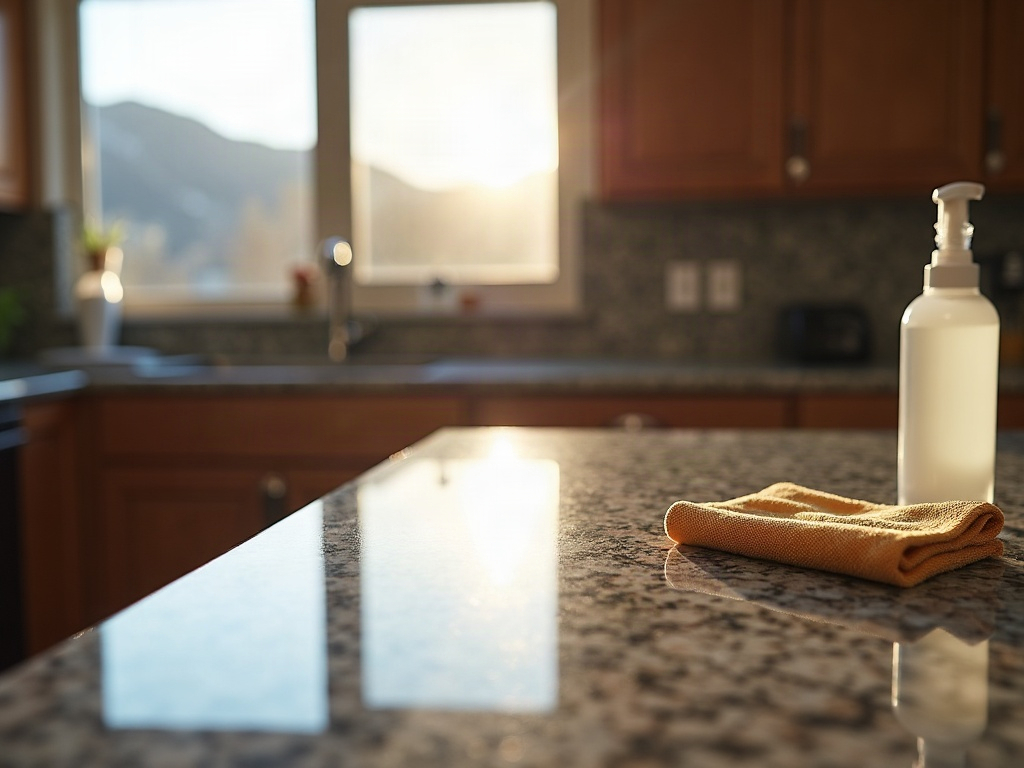
The product needs to be specifically formulated for natural stone, with a pH between 7 and 9. We use Miracle Sealants Stone and Tile Cleaner on granite surfaces because it is pH-balanced, leaves no residue film, and is safe for polished, honed, and leathered finishes. Apply it to a microfiber cloth, not directly to the counter. Spraying directly onto horizontal stone lets the product pool in low spots and along the backsplash edge, where it dwells longer than intended. In Lafayette homes where we have worked in Indian Peaks and Centaur Village, the difference between a properly pH-neutral product and a mildly acidic one shows up clearly in the countertop's finish over a 12-month period.
Vinegar is the most common offender, but it is not alone. Citrus-based cleaners, most general-purpose kitchen sprays, bleach, hydrogen peroxide, ammonia-based glass cleaners, and any product not explicitly labeled safe for natural stone all pose acid or alkaline damage risk to granite and its sealer. Grout cleaners are another frequent problem. Many are highly acidic and safe for ceramic tile grout while being actively harmful to any natural stone surface nearby. If the label does not say "safe for natural stone" or give a pH range, do not use it on granite.
Even with a quality sealer in place, acidic liquids sitting on granite create risk. Red wine, coffee, citrus juice, and tomato sauce all have a pH low enough to damage the stone surface if they sit for more than a few minutes. Blot spills rather than wiping them in a spreading motion. Wiping spreads the liquid across more of the surface before it is lifted. Blotting contains it. This matters most on honed or leathered finishes, which are more porous than polished granite and absorb liquids faster.
A granite countertop in an active kitchen typically needs resealing once a year. High-traffic cooking surfaces may need it every eight to ten months. The simple test: place a few drops of water on the counter and wait three minutes. If the water beads up and rolls off, the sealer is holding. If the water darkens the stone where it sits, the sealer has depleted and it is time to reseal. We recommend StoneTech BulletProof Sealer for polished granite in kitchens because it penetrates without leaving a surface film and holds up under regular use longer than lighter-duty consumer sealers. Skipping the resealing schedule and continuing to use vinegar is the fastest way to reach a point where professional restoration is the only correction available.
For day-to-day cleaning between deeper passes, warm water on a microfiber cloth handles light residue on sealed granite without any product at all. For cooking residue or grease, a small amount of pH-neutral dish soap diluted in warm water, applied with a damp microfiber cloth and followed immediately by a clean water rinse and a dry buff, cleans effectively without acid exposure. Dry the surface after cleaning rather than letting it air dry. Colorado's hard water leaves mineral deposits as it evaporates, and those deposits are visible on polished granite in direct southern light, which Lafayette homes on the Front Range get most of the year.
Granite that has been cleaned with vinegar or acidic products for an extended period has likely lost much of its sealer and may show dulling or micro-pitting that routine cleaning does not address. A professional stone cleaning and resealing service can reset the surface and extend its life significantly. This is different from a standard home cleaning visit. Stone restoration professionals use penetrating cleaners, mechanical polishing for etched areas, and commercial-grade sealers that are not available in consumer packaging. If your granite countertops look consistently dull despite regular cleaning, that is the scenario that warrants a stone restoration consultation before you invest more time in maintenance that cannot reverse the existing damage.
When we take on a new client in Lafayette, the first thing we do is identify the surface materials throughout the home before selecting any product. Granite, quartz composite, marble, and laminate all look similar to a casual glance and require completely different cleaning approaches. Quartz composite has a resin binder that tolerates a different pH range than natural granite. Marble is more sensitive to acid than granite. Applying the same product across all four surfaces produces the right result on at most one of them.
For granite specifically, we bring pH-neutral stone cleaner and use nothing else on those surfaces. We do not substitute general-purpose kitchen spray, even when the label says "safe for most surfaces." That qualifier matters. Most surfaces is not the same as natural stone, and the distinction is significant when a countertop installation runs $60 to $100 per square foot installed.
We also check the water bead test on granite during first visits for new clients. If the sealer has depleted, we let the homeowner know. That is not a task we handle, but knowing the status of the sealer tells the homeowner whether their countertop is adequately protected or whether it needs attention from a stone restoration professional before routine cleaning can do its job properly. The number one thing our clients mention in reviews is attention to detail and consistency, and catching a depleted sealer during a first visit is exactly the kind of detail that makes a measurable difference for the surface over time.
For Lafayette homeowners who want to know how we approach a first visit and what surfaces we address at what level of detail, the Lafayette house cleaning page covers how we structure the initial deep clean in this area. We serve Indian Peaks, Coal Creek Ranch, Old Town Lafayette, and Centaur Village, and the surface inventory varies across those neighborhoods. What does not vary is using the right product for each material.
For homeowners wondering how the products we select across all surfaces intersect with pet and child safety in the home, the post on what people get wrong about eco-friendly cleaning products and pets covers how surface-specific product choices play out in households where chemical exposure matters more.
If your home has granite, marble, or other natural stone and you want a crew that treats those surfaces correctly on every visit, you can reach us at 303-827-1251 during business hours. You can also read about how we vet and train our team on the about page before you decide.
The post on what most people get wrong about cleaning hardwood floors applies the same surface-specific product logic to another material that suffers from well-meaning but wrong cleaning advice. And if you are comparing visit types or thinking about recurring service for a Lafayette home, our post on recurring cleaning versus a one-time deep clean walks through how those options compare in practice.
No. Vinegar has a pH of around 2.5, which is acidic enough to gradually dissolve the sealer on granite and etch the stone surface beneath it. The damage is cumulative and slow, so it is not visible after one use. After months of regular vinegar cleaning, the finish degrades into dullness, micro-pitting, and uneven light reflection that no cleaning product reverses. The only options at that point are professional stone restoration or living with the degraded finish. Granite countertops in Lafayette kitchens, whether in Indian Peaks, Coal Creek Ranch, or Old Town, should be cleaned only with a pH-neutral stone cleaner. The same rule applies to all other natural stone surfaces including marble and travertine. Vinegar is a reasonable cleaner for ceramic tile, laminate, and glass. It does not belong on natural stone.
Use a pH-neutral cleaner specifically formulated for natural stone. We use Miracle Sealants Stone and Tile Cleaner on granite surfaces in the Lafayette homes we service because it is pH-balanced, rinses clean without residue, and works on polished, honed, and leathered granite finishes. Apply it to a microfiber cloth rather than spraying directly onto the counter. Spraying onto a horizontal stone surface lets product pool along the backsplash edge and in any low spot, where it sits longer than intended. Follow with a dry microfiber buff before the cleaner air-dries, because Colorado's hard water leaves mineral deposits on polished granite as tap water evaporates. For day-to-day maintenance between deeper passes, warm water on a microfiber cloth handles light residue without any product at all.
The water bead test takes about three minutes and gives you a clear answer. Place a few drops of water on the counter surface and wait. If the water beads up and rolls off cleanly, the sealer is intact. If the water darkens the stone where it sits, the sealer has depleted and the granite is absorbing liquid directly. A depleted sealer means liquids and cleaning products contact the stone itself rather than a protective layer, which accelerates staining and acid damage from any product that touches the surface. Granite in an active kitchen typically needs resealing once a year. Homes where countertops have been cleaned with vinegar or acidic products may need resealing sooner because acid exposure breaks down the sealer faster than normal use does. If the test shows absorption, a stone restoration professional can reseal the surface before routine cleaning can work effectively again.
Mild pH-neutral dish soap diluted in warm water is safe for granite when used correctly. Apply it with a damp microfiber cloth, follow immediately with a clean water rinse pass to remove all soap residue, and dry the surface with a clean cloth before it air-dries. The key step most homeowners skip is the rinse pass. Soap left on the granite surface builds up over repeated cleanings and creates a film that dulls the finish. Undiluted dish soap applied directly and left on the surface is more problematic because the higher concentration takes longer to rinse fully. For daily maintenance, warm water alone handles light residue on properly sealed granite without any soap at all. Reserve the diluted soap solution for actual cooking residue or grease, not as a daily wipe-down product.
Granite countertops benefit from professional cleaning as part of a regular home cleaning schedule rather than as a standalone service. For active Lafayette kitchens in Indian Peaks or Coal Creek Ranch that see daily cooking use, monthly professional cleaning keeps the surface in good condition and prevents residue buildup that eventually requires more intensive treatment to address. Between professional visits, the right daily routine is straightforward: pH-neutral product or warm water on a microfiber cloth, spills blotted immediately rather than spread, and the surface dried after cleaning to prevent hard water deposits. The variable that shortens the interval between professional visits faster than anything else is using the wrong product at home. Vinegar, citrus sprays, and general-purpose kitchen cleaners applied regularly between professional visits create a surface condition that is harder to maintain regardless of how often the crew comes through. Our Lafayette house cleaning page covers how we structure recurring visits for homes with natural stone surfaces in this area.
If your Lafayette home has granite countertops that need a proper reset, or you want a cleaning crew that uses the right products on every surface from the first visit forward, put your details into our booking page and we will confirm the scope and price for your specific home before anyone arrives.