October 15, 2026

Erie handed over more new construction keys in 2024 and 2025 than any other town in Boulder County, and we cleaned dozens of those homes before families moved in. Every single one had something the builder missed. Not because the builder was careless, but because post-construction cleanup and move-in-ready cleaning are two completely different jobs. Builders hire crews to remove obvious debris. They do not hire crews to deal with what those jobs leave behind inside the walls, ducts, and fixtures.
If you just closed on a new build in Vista Ridge, Erie Highlands, or Compass, this post is worth reading before you unpack a single box. Here is what is actually in that house right now, and how to address it properly.
Construction cleanup crews sweep floors, remove material scraps, and wipe the most obvious surfaces. That is the scope they are hired for. What they leave behind is a different list entirely.
Fine drywall dust settles into air ducts and sits behind light fixtures and outlet covers for six to twelve months after keys are handed over. You cannot see most of it. The first time your HVAC system runs at full capacity, it redistributes that dust throughout the home. Counters you wiped two days ago are coated again. That is not a fluke. That is construction particulate cycling through the system.
Caulk smears show up on tile, glass, and countertop edges. Paint overspray lands on hardware, window tracks, and flooring near trim work. Grout haze coats tile surfaces in bathrooms and kitchens where tile was installed during the final weeks of construction. Adhesive residue from protective films left on appliances and fixtures often gets partially removed, leaving a sticky edge. None of this is visible from across the room. All of it becomes apparent the first week you live there.
The common thread is that construction dust is not like household dust. It is finer, it carries a slight charge, and it bonds to surfaces more stubbornly. Standard household cleaning products and a quick wipe-down do not remove it the same way they remove everyday dust. It requires a specific approach, in a specific order, with the right tools.
The most common mistake we see when homeowners attempt their own new construction clean is starting with the floors. It makes intuitive sense. The floors look dirty and that is the first thing you notice when you walk in. But floors are the last thing you should address, not the first.
Construction dust drifts downward. When you disturb surfaces higher up, the particulate resettles on whatever is below. Clean the floors first, then wipe a dusty ceiling fan, and you are cleaning the floors again. Do this a few times and frustration sets in. The solution is a strict top-to-bottom order, with HVAC addressed before any surface cleaning begins.
Skipping the air ducts is the other critical error. New construction homes in Erie's newer subdivisions have fine drywall dust in the air ducts and behind fixtures for six to twelve months after move-in. Cleaning every surface in the home while the HVAC system cycles that dust back through is a losing battle. Address the ducts and vents first, change the filter, then start on surfaces.
Replace the HVAC filter before running the system. New construction leaves drywall dust and fine particulate in the ductwork. Running a standard 1-inch filter through an initial construction dust cycle clogs it quickly and redistributes fine particles throughout the home. Use a MERV 11 or higher rated filter for the first several months. While you have access to the vents, remove each vent grille and wipe the inside of the duct opening as far back as you can reach with a damp microfiber cloth. Wipe the grille face and reinstall. This step determines whether every surface you clean stays clean. Skip it and you are cleaning the same surfaces repeatedly.
Start at the highest point in each room and work down. Ceiling fan blades in new construction homes collect a thick layer of construction dust during the build. Use a dry microfiber cloth for the first pass on fan blades. Follow with a lightly damp cloth. On light fixtures, remove the glass covers if accessible and rinse them separately. Construction dust inside a fixture creates a haze that affects the light quality. Wipe the fixture housing and reinstall. Crown molding, door frame tops, and the tops of kitchen cabinets all carry the same construction dust load. Address them in order, top to bottom, room by room.
Cabinet interiors in new construction have a film of fine sawdust from trim cutting and installation. This is easy to miss because the doors are closed. Open every cabinet and drawer before you put a single dish or item inside. Wipe the interior with a dry microfiber cloth, then follow with a lightly damp cloth. Pay attention to the drawer tracks. Fine sawdust in drawer slides causes them to stick and grind. A quick wipe of the slide channel prevents that. This step takes about twenty minutes per kitchen and is worth every minute of it.
These three categories require different products. Caulk smears on tile and countertops respond to a plastic scraper at a low angle followed by a clean microfiber cloth. Do not use a metal scraper on tile. On glass surfaces, a razor blade window scraper at a shallow angle removes caulk without scratching if the glass is wet first. Paint overspray on hardware, hinges, and window tracks responds to a cotton swab with mineral spirits. Apply carefully and wipe immediately. Adhesive residue from protective film responds to Goo Gone applied on a cloth, dwell for sixty seconds, then wipe. Avoid spraying any solvent product directly onto stone or composite countertop surfaces. Apply to the cloth, not the surface.
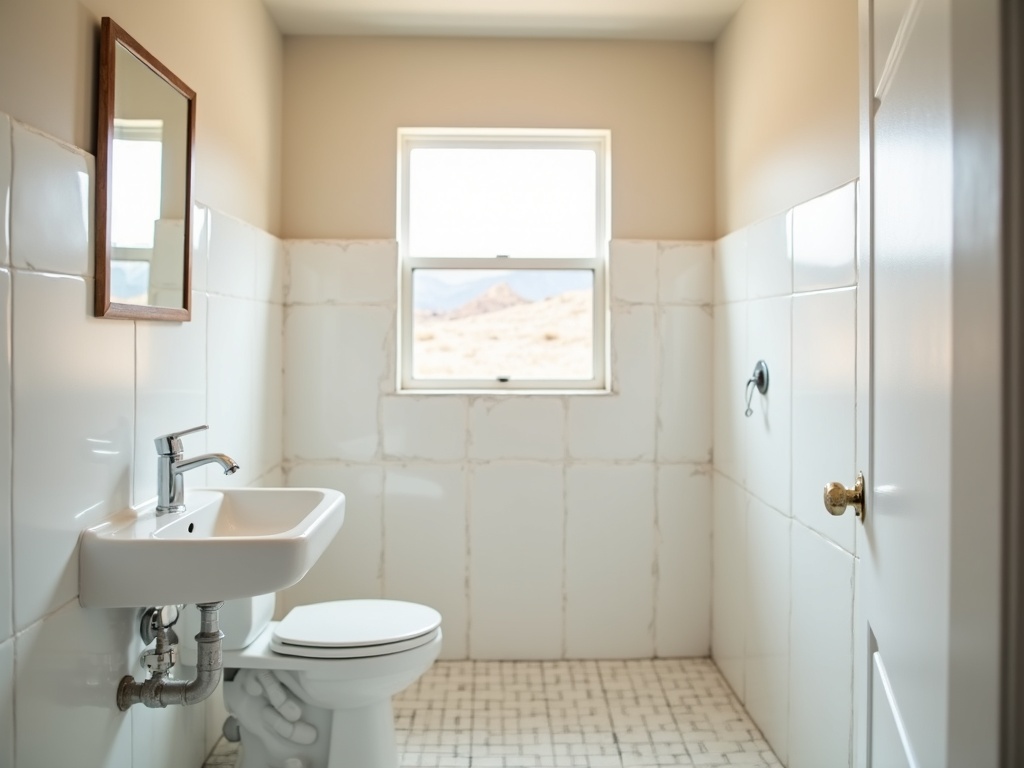
Grout haze is a thin film left on tile surfaces after grouting. It is not always visible in normal light, but it becomes obvious in direct sun or with a flashlight held at a low angle. In Erie's new builds, bathrooms and kitchen backsplashes often have grout haze from installation in the final construction weeks. A diluted sulfamic acid cleaner or a commercial grout haze remover applied with a scrub pad removes it without damaging the tile. Test in a small area first. On natural stone tile, use only a pH-neutral cleaner. Acidic grout haze removers will etch stone and cannot be undone. Once the haze is removed, rinse the tile surface thoroughly with clean water and dry with a clean cloth before moving on.
New construction windows have construction grime, sticker residue, and in many cases, concrete or mortar splash on the exterior glass from foundation work. Clean the exterior glass first so you are not looking at exterior grime while finishing the interior. On the interior, window tracks in new builds collect construction dust and small material chips that were not removed during the builder cleanup. Vacuum the track channel with a crevice attachment before wiping. A cotton swab reaches the corners where a cloth does not. Wipe the full frame and sill with a damp microfiber cloth. Finish with glass cleaner on the pane, working top to bottom to prevent drips onto already-cleaned sections.
With all overhead and surface work complete, floors are finally ready. Vacuum first, regardless of floor type. Even on hardwood, a vacuum pass removes the fine particulate that mopping would push into the wood grain or flooring joints. Use a soft brush attachment on hardwood floors. After vacuuming, mop hardwood with a pH-neutral cleaner applied to the mop pad, not sprayed directly onto the floor. Construction homes in Erie's dry climate are especially vulnerable to moisture damage in hardwood at the joint lines during the first year when the wood is still acclimating. On tile, a standard alkaline cleaner works well to lift the construction film from the tile surface. Grout lines should be the last thing addressed, with a stiff grout brush and appropriate cleaner.
New construction surfaces are often freshly sealed or recently finished. That changes the product selection. Aggressive cleaners that work fine on a five-year-old bathroom can strip a newly applied sealant or damage a fresh finish on the first clean.
On hardwood floors, we use Bona Hardwood Floor Cleaner. It is pH-neutral, leaves no residue, and does not interfere with the factory finish on new construction hardwood. New hardwood in Erie's dry climate takes several months to fully acclimate to indoor humidity levels. Moisture-heavy floor cleaners speed up the expansion and contraction cycle during that period. Bona's formulation minimizes that risk.
On tile and grout, we use a diluted alkaline cleaner for the general surface and a dedicated grout haze remover where needed. We avoid vinegar-based cleaners on grout in new builds. Vinegar works on mineral deposits and hard water scale, but it is acidic enough to begin degrading fresh grout sealant with repeated use.
On general surfaces, including cabinets, countertops, and trim, we use a plant-based multi-surface cleaner. It does not leave a film that attracts new dust, which matters in a new construction home where dust is still settling. We switched to this product line specifically because it handles construction residue without requiring heavy scrubbing on freshly finished surfaces.
For caulk and adhesive removal, mineral spirits on a cloth handles paint and adhesive, and a plastic scraper handles caulk smears. We do not use abrasive pads on any surface in new construction. The finishes are too new and too easily scratched.
A new construction clean on a 2,000-square-foot home in Erie Highlands, done correctly, takes four to six hours with two experienced cleaners who know what to look for. Done by a single person working alone and covering the steps as they go, the same job typically takes twelve to fifteen hours across multiple days. By then, construction dust has settled again on surfaces cleaned on day one.
The practical threshold is this: if your home is over 1,800 square feet, has more than two bathrooms, or includes tile floors throughout multiple rooms, the scope of a proper new construction clean exceeds what most homeowners can cover efficiently before exhaustion sets in. It is not about skill. It is about the combination of time, tools, and product knowledge required to do all of it in the right order before the dust settles again.
New construction cleaning also requires a different product kit than what most households own. Grout haze remover, pH-neutral hardwood cleaner, mineral spirits for adhesive removal, and a MERV 11 filter are not items that sit in the average cabinet. Buying them for one use costs nearly as much as booking a professional clean.
Our Erie house cleaning service handles new construction cleans regularly across Vista Ridge, Erie Highlands, and Compass. We know the specific finish materials used in Erie's most active builders' communities and bring the right products for each surface type. For context on what this type of cleaning costs, our post on house cleaning costs in Erie covers the pricing range in detail. Our post on post-construction dust in Berthoud's new neighborhoods covers the same particulate problem in a nearby market with similar new construction conditions. For homes that have been through a renovation rather than new construction, our post on cleaning after a renovation before moving back in walks through the specific differences.
For a broader look at how dust in Front Range homes accumulates differently than in other climates, our post on why Front Range dust is different gives useful background. And if you are deciding between a one-time deep clean and setting up ongoing service after move-in, our post on recurring cleaning versus a one-time deep clean walks through the cost comparison clearly.
To get your Erie new construction home scoped and scheduled, call us at 303-827-1251 during business hours and we will tell you exactly what your home needs based on its size and finish materials. You can also book directly online and tell us what the builder left behind.
A thorough new construction clean in Erie covers HVAC vent cleaning and filter replacement, all cabinet and drawer interiors, ceiling fans and light fixtures, window tracks and frames, grout haze removal from tile surfaces, caulk smear and adhesive residue removal from glass and countertops, paint overspray removal from hardware, and a complete top-to-bottom surface wipe followed by floors last. This scope is different from a standard house clean. The order matters as much as the tasks. Construction dust resettles quickly, so the sequence from ducts to overhead surfaces to mid-level surfaces to floors is what makes the clean hold. Our Erie house cleaning page covers what we include for new construction jobs specifically.
Fine drywall dust and construction particulate remain active in the air ducts and behind fixtures for six to twelve months after the builder hands over keys. The first several heating and cooling cycles redistribute it throughout the home. You will notice surfaces re-dusting within days of a first clean if the ductwork has not been addressed. Homes in Erie's Vista Ridge and Erie Highlands neighborhoods are particularly affected because the volume of nearby active construction means outdoor construction particulate adds to the indoor load during the first year. Replacing the HVAC filter with a MERV 11 rated filter immediately after closing, before running the system at full capacity, reduces how much of that dust circulates into living spaces.
You can do it yourself if the home is under about 1,500 square feet and you have two full days available, the right product kit, and the patience to work in strict top-to-bottom order without shortcuts. For most new construction homes in Erie, which typically run 2,000 to 3,500 square feet with tile in multiple rooms and hardwood in main living areas, a professional crew covers the job in four to six hours and brings the product knowledge to handle grout haze, adhesive residue, and fresh finishes without damage. The risk of DIY in new construction is not effort. It is using the wrong product on a new finish and damaging something that cannot be easily repaired. Our Erie cleaning cost post gives pricing context for what a professional clean runs in this market.
Builder cleanup crews remove construction debris and do a surface sweep. They consistently miss cabinet and drawer interiors, which collect sawdust from trim and installation work. HVAC ducts are almost never addressed during builder cleanup. Grout haze on tile is left for the homeowner to discover. Caulk smears on glass, countertops, and tile edges are common and rarely removed fully. Adhesive residue from protective films on appliances and fixtures is partially removed but leaves sticky edges. Paint overspray on window tracks, hinges, and hardware shows up in nearly every new build. None of these items fail a builder inspection. All of them affect your first weeks in the home if they are not addressed before you move in. Our Erie service page explains how we approach these homes specifically.
Schedule the new construction clean before moving any furniture or boxes into the home. Once furniture is in place, access to floors, baseboards, and cabinet interiors is limited and the clean is less thorough. Ideally, book the clean within a week of closing, after you have done a walkthrough with the builder and addressed any outstanding punch list items. If the punch list involves additional trades coming back into the home after closing, wait until that work is complete before cleaning. Every additional contractor visit reintroduces construction dust. You can check our availability and book your new construction clean online, or call us to discuss timing based on your specific closing and move-in schedule.
Your new Erie home deserves a proper start. Book your new construction clean online and we will get it move-in ready before the first box comes through the door.